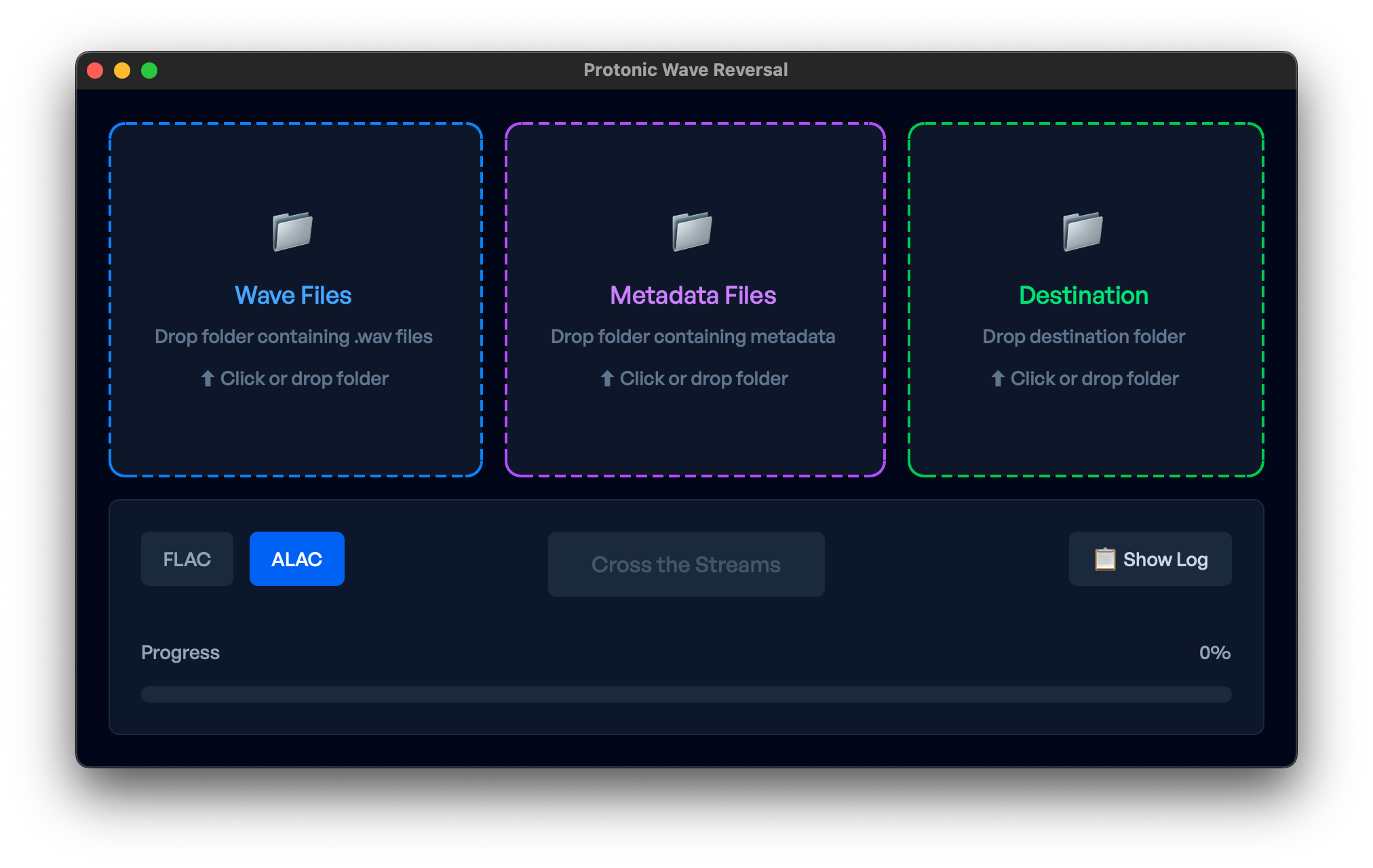
Building Protonic Wave Reversal
How Bleep and Plexamp got to me build a niche audio converter

Jimmy Penlesky
Bleep This
I have a Bleep-ing problem.
High-resolution audio files from artists like Autechre and Aphex Twin, gathered from Bleep or ripped from CDs, all living in a meticulously organized Plexamp library. If you’re going to listen to electronic music, you might as well hear every nuance intended. At 44.1kHz/24-bit or greater. Like a reasonable person.
There’s just one problem: WAV files don’t support metadata. No artist names, no album info, no album art. Just artist-01-track.wav through artist-12-track.wav sitting in a folder, mocking my organizational instincts. Bleep does include MP3 or Free Lossless Audio Codec (FLAC) files with proper tags alongside the high-resolution WAVs, but manually copying metadata to hundreds of converted files is the kind of soul-crushing busywork that makes you reconsider your commitment to audio fidelity. Almost.
I wrote a Python script to deal with it. Point it at a folder of WAVs and their metadata companions, and it would convert everything to Apple Lossless Audio Codec (ALAC) while transferring all the tags and album art. It was beautify and worked perfectly. For me, in the terminal, with the right folder structure and no typos in the file paths.
Eventually that got old. Every time I bought a new album and had to fire up the terminal drag in folders and lookup syntax, it felt like there should be a better way. I wanted drag and drop and click. Something I could share with other people who have this same uniquely specific problem.
Building My First macOS App
I had been using Claude Code for small-scale web development but never for a full macOS application, so I figured it was time to find out what that looked like. The first few iterations were rough, over 300MB and visually atrocious, but functional enough to keep going. After some iteration with nuitka the size settled at an acceptable 90MB with solid launch times. Sketching the interface in Figma and using the Figma Model Context Protocol (MCP) server got the final look where I wanted it.
The name came from this site which was to be my future development home. Spectral Run has audio and ghost connotations, which got me thinking about Ghostbusters. In the movie, crossing the streams causes a “total protonic reversal.” This tool is literally about crossing streams safely, taking audio data from one format and metadata from another and combining them without everything exploding. It fit. And it sounds better than “Bleep HiRes Converter.”
I still wish Bleep would release high-resolution ALAC or FLAC files like Bandcamp does, but until then, Protonic Wave Reversal does the job. Cross the streams.